
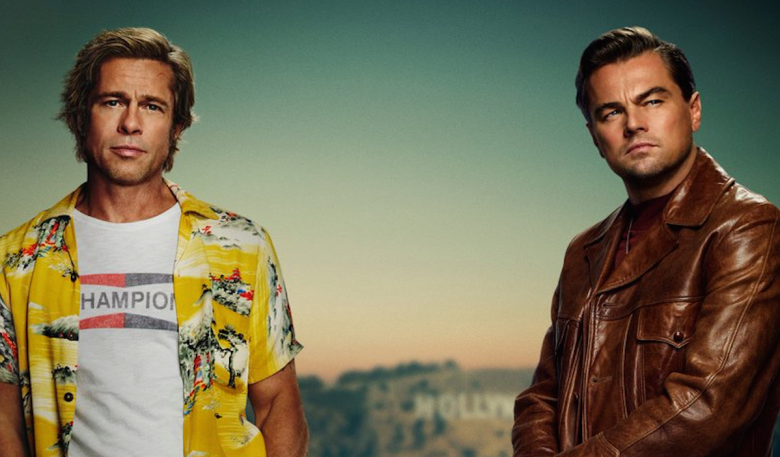
An ode to the glimmering city of Hollywood, Tarantino’s ninth installment, ‘Once Upon A Time In Hollywood’ hits the box office with a particularly surprising tale that left me wanting just a little more. (I must warn there are a few spoilers ahead for those who have yet to see it!)
Tarantino’s approach to filmmaking is one that immediately separates himself from the rest. Known for beginning his scripts with music preceding its narrative, Tarantino takes his viewers on a journey that appears to go one way, but quickly derails. His newest edition to which he describes as his “love letter to classic Hollywood” begins with a relaxed plot, which I must admit, kept me on my toes. It felt as if Tarantino was leading up to a major reveal. (And to my surprise, I was correct!)
We are first introduced to Rick Dalton (Leonardo DiCaprio) and Cliff Booth (Brad Pitt) who are the first of many that made up the star-studded cast. Dalton, a once rising television star in the 1950s, finds himself lost in the new age of Hollywood. During the late 1960s, America had its hands tied with the backlash of the Vietnam War, Watergate and an inability to suppress the growing hippie movement. Hollywood in particular was a great indication of the audiences’ growing distaste for musicals and family affairs; they craved an anti-hero who would neither know success or prosperity. This film exploits this very topic.
Dalton, like many actors of the time, floundered in 1960s Hollywood with an unforeseeable career and dangling promises of a successful pilot season. Stunt double, Cliff Booth is a relaxed character who is essentially in it for the ride. Pegged for murdering his wife (and getting away with it), Booth much like Dalton is also struggling to find his way given his reputation. Living next door to Dalton is Hollywood’s up and coming star, Sharon Tate (Margot Robbie). Tate appears to have it all, but as we soon find out, also struggles with maintaining fame amongst moviegoers of the day.
Once Upon A Time has a few underlying themes that appear to be the center of the story but to my disappointment, appeared to be ornaments as oppose to major thematic points. One of the drawing points of this film for me was the introduction of one of the world’s most notorious serial killer groups, the Manson Family. I was particularly interested in how Tarantino would adapt the story of the murder that stirred America. Unfortunately, we only see Manson (Damon Herriman) once, which is the same scene presented in the trailer. I felt the rug had been pulled from under me learning that he would only play a minor role as too would Lynette ‘Squeaky’ Fromme (Dakota Fanning).
Why build them up and then take them away from us? One of the most puzzling aspects of the film is Tarantino’s quick introduction and conclusion of these characters when advertising them as far more.
I thoroughly enjoyed how each shot was crafted and the fact that it was shot on 35mm film (one of my favorite Tarantino traditions). A full A+ in the production design department! Hollywood in the 1960s is one of my favorite periods of time which is why I am so conflicted with how I feel about the film. It had the look, but the film was composed of far more exposition than narrative; perhaps the pacing could have been improved. However, what Tarantino does make evident in the narrative’s character arc, is that Dalton’s fear of being a has-been is simply that, a fear; assuring Dalton he is worth far more than he gives himself credit for.
When it came down to the final twenty minutes of the film, Tarantino threw the most unforeseeable wrench in the plot I’d ever seen. (Maybe that’s his magic?) The original events of the Tate murder are completely derailed and instead follow the Manson family into Dalton’s house where Booth’s career as a stunt man will ultimately prevail. It was bloody, loud and definitely had Tarantino written all over it. While I appreciated the historical turn of events, I couldn’t help but feel that everything we learned in the past two and half hours led to what felt like a quick and messy resolve.
Overall, the comedy and innovation of the story was absolutely fantastic and created a positive consensus amongst the audience. (based on the audible laughs and gasps of horror in it’s finale) However, I found the lack of Manson (and others’) involvement in the film as my ultimate resolve of the film. It was aesthetically stunning with just the right amount of comedy as any Tarantino film should have; but I still felt like it was missing some meat in its narrative. Major props to the entire cast, both veteran and new as they all truly embodied each of the characters. (Especially Margaret Qualley who really took the reigns of one of her first major roles) Ultimately, I’d give this film a B for its creative take of 1960s Los Angeles and its irreplaceable cast who really made the film. Again, I wish I was given just a little more in its narrative. Is it Oscar worthy? We will have to wait and see!
What did you think? Was Once Upon A Time In Hollywood everything you imagined? Let me know in the comments!
Photo credit: https://people.com/movies/leonardo-dicaprio-unveils-once-upon-a-time-in-hollywood-poster-brad-pitt/
 That’s A Wrap: Film Reviews